


7 Indoor Dog Training Games for Cold Winter Days

Winter has settled in. The days are short, the wind is biting, and the thought of another long walk in the sleet is enough to make anyone shiver. But while you’re sipping hot cocoa by the window, have you noticed your dog giving you that look? The one that says, “I’m bored!” and “I have energy to burn!”
When the weather outside is frightful, our canine companions can quickly become restless. A lack of exercise and mental stimulation often leads to what we call “the winter crazies”—chewing, barking, zoomies around the couch, and general mischief. But here’s the good news: physical walks are just one way to tire a dog out. Mental exercise is just as exhausting, if not more so, for your pup’s brain.
This winter, transform your living room into a fun-filled training center! Engaging in indoor training games is the perfect solution to strengthen your bond, reinforce vital obedience skills, and provide the critical enrichment your dog needs—all while staying warm and dry. Let’s dive into seven fantastic games that will make your dog happily tired and keep their mind sharp all season long.
1. The “Find It” Scent Work Game

Boosting Your Dog’s Natural Sniffing Instincts Indoors
Dogs experience the world through their noses. For them, sniffing is like reading a fascinating, ever-updating newspaper. The “Find It” game taps directly into this powerful, natural instinct. It provides deep mental engagement, as your dog has to focus and problem-solve using their primary sense. This kind of indoor nose work is incredibly satisfying and tiring for dogs of all ages and energy levels, from a laid-back senior to a bouncy puppy.
How to Play Find It: From Beginner to Advanced
This game is beautifully simple to start and endlessly adaptable. You only need some small, smelly treats or pieces of your dog’s regular kibble.
Beginner Level: With your dog watching, toss a treat a short distance on an open floor and cheerfully say, “Find it!” As they get the idea, start tossing treats in slightly harder-to-see spots, like near a chair leg or under the edge of a rug.
Intermediate Level: Ask your dog to “Stay” or have a family member gently hold their collar. Let them watch you place treats in 2-3 obvious spots in the room. Then release them with your enthusiastic “Find it!” command.
Advanced Level: This is where the real mental stimulation for dogs kicks in. Place your dog in a separate room or behind a baby gate. Hide treats in increasingly clever places around your living area—on a low shelf, under a pillow, or on the seat of a chair. Return to your dog, build the excitement, and give the command. Watch as they burst into the room, nose to the ground, to hunt for their prize.
Pro Tip: You can upgrade from treats to hiding a favorite toy. Start by letting them see you hide it, and progress to making them search for it solely by scent.
2. DIY Indoor Agility & Obstacle Course
Creating a Safe Home Agility Setup
You don’t need expensive equipment to create a fun agility challenge. Your living room is full of possibilities! The key is to prioritize safety: use non-slip surfaces (carpets or rugs over hardwood) and avoid anything wobbly or sharp.
Jumps: Use a broomstick or mop handle resting on two stacks of books or low boxes. Start with it on the ground and slowly raise it only a few inches.
Tunnels: Drape a blanket or sheet between two chairs.
Weave Poles: Set up a line of upright water bottles or toilet paper tubes.
Pause Box: Use a yoga mat, small blanket, or even a cardboard box taped flat as a “place” to stop.
Table: Use a sturdy, low stool or ottoman for “on/off” commands.
Training Commands and Building Confidence
This course is about control and teamwork, not speed. Use it to practice vital obedience cues.
Lead the Way: Use a treat in your hand to lure your dog over the jump, through the tunnel, and around the weave poles. Pair each obstacle with a clear command like “Over,” “Tunnel,” and “Weave.”
Add a Sequence: Once they understand each piece, try linking two obstacles together. For example, “Tunnel” then “Over.”
Incorporate Stays and Releases: Have your dog “Wait” at the start, then release with “Okay!” Ask for a “Sit” or “Down” on the pause box in the middle of the course.
This game builds incredible physical coordination, listening skills, and confidence in a small space.
3. Reinforce Manners with the “Box” or “Place” Game

Teaching a Calm Settle with the Place Command
The “Place” command (sometimes called “Mat,” “Bed,” or “Box”) is one of the most useful skills you can teach. It means your dog goes to a specific spot—a dog bed, mat, or even a marked tile—and stays there calmly until released. It’s a lifesaver for moments like when the doorbell rings, you’re cooking dinner, or you simply need them to unwind. This is the ultimate calm settle exercise.
Step-by-Step Training for Duration and Distraction
You’ll need a designated mat and plenty of treats.
- Step 1: Target the Mat. Toss a treat onto the mat. The moment your dog steps on it to get the treat, say “Yes!” (or click) and give another treat. Repeat until they eagerly move toward the mat.
- Step 2: Add the Cue. Just as they are about to step on the mat, say “Place.” Reward them while they are standing on it.
- Step 3: Build Duration. Now, pause for one second before giving the treat. Slowly increase the time to 3 seconds, then 5, then 10. Feed treats frequently while they are staying on the mat.
- Step 4: Add Distance. Take one small step back from the mat. If they stay, return to reward. Gradually increase your distance.
- Step 5: Gentle Distractions. Finally, add mild distractions while they are holding their “Place,” like clapping your hands or taking a step to the side. This builds powerful impulse control training for dogs.
Practice this daily in short, 3-5 minute sessions. You’ll be amazed at how this game teaches your dog an “off-switch.”
4. Interactive Puzzle Toys and Food Dispensers
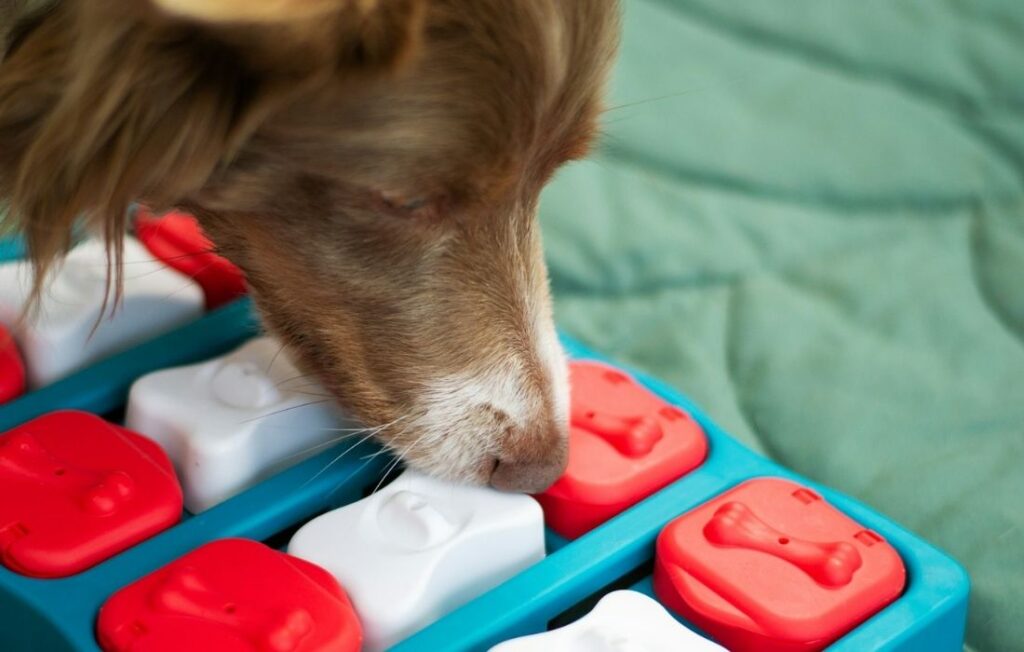
Choosing the Right Puzzle Toy for Your Dog’s Skill Level
Puzzle toys turn mealtime into a brain game. They require your dog to slide, lift, flip, or spin parts of the toy to release kibble or treats. It’s fantastic indoor enrichment for dogs.
- Beginner Puzzles: Look for simple “muffin tin” styles or toys with easy-to-slide compartments. A classic DIY version is putting kibble in a muffin tin and covering each cup with a tennis ball.
- Intermediate Puzzles: These have multiple steps, like toys with layers that need to be removed or different types of manipulators.
- Advanced Puzzles: These are complex, with sequential steps and hidden compartments. They’re perfect for brilliant, persistent dogs who need a real challenge.
Maximizing Mental Engagement During Mealtime
Instead of pouring your dog’s entire dinner into a bowl, use it as training currency!
- Use a portion for your obedience training sessions (like “Place” or “Touch”).
- Put the remaining portion into a puzzle toy or food-dispensing ball.
- Let your dog work for their meal. This 20 minutes of problem-solving is far more exhausting than gulping down food in 20 seconds.
Remember to supervise initially to ensure your dog is engaging safely with the toy and not getting frustrated.
5. Refine Obedience with the “Touch” Targeting Game
The Versatility of the Touch Command
“Touch” is a deceptively simple but incredibly powerful command. It means your dog will deliberately touch their nose to the palm of your hand. This game builds focus, strengthens your recall foundation, and gives you a positive way to move your dog without pushing or pulling.
Fun Targeting Drills to Practice Indoors
- Getting Started: Present your flat palm, close to your dog’s nose. The moment they sniff or bump it, say “Yes!” and give a treat with your other hand. Repeat until they are actively booping your palm. Then, add the verbal cue “Touch” just as they move to do it.
- Drill 1: Follow the Hand. Practice having your dog “Touch” your hand as you move it to the left, right, up high, and down low. This improves their focus and flexibility.
- Drill 2: Send Aways. Ask your dog to “Touch” your hand while it’s held against a wall, a chair, or even the refrigerator door. This teaches them to move away from you to a target, which is the basis for sending them to their bed or through an agility tunnel.
- Drill 3: Spin and Twist. Use your “Touch” hand to guide your dog in a circle for a fun “Spin” trick.
It’s a low-impact, high-reward game that’s perfect for small spaces.
6. Impulse Control with “Leave It” and “Wait” Drills

Strengthening Your Dog’s Self-Control Skills
“Leave It” and “Wait” are cornerstones of good manners, but they mean different things.
“Leave It” means: “That thing is not for you, ever. Stop focusing on it.”
“Wait” means: “Pause and hold your position. I will give you permission to move soon.”
Practicing these in a controlled, indoor setting builds incredible patience and discipline.
Indoor Training Exercises for Leave It and Wait
For “Leave It”:
- Hold a low-value treat in a closed fist. Present it to your dog. They will likely sniff, lick, or paw. The moment they pull their nose away, say “Yes!” and reward them with a different, higher-value treat from your other hand.
- Progress to placing a treat on the floor and covering it with your hand. Use the same principle: when they stop trying to get it, mark and reward from your stash.
- Slowly make it harder: cover the treat with just your fingers, then eventually leave it uncovered but be ready to cover it if they lunge.
For “Wait”:
- Start at a doorway. Ask your dog to “Sit.” Say “Wait” in a calm, steady voice, open the palm of your hand like a stop sign, and take one small step through the doorway. If they hold, immediately return and reward in the sitting position.
- Practice before meals: ask for a “Sit” and “Wait” as you lower the bowl. Only release to eat with an “Okay!”
- Use “Wait” to practice self-control with toys: ask for a “Wait” before you throw a ball.
7. Hide-and-Seek with People or Toys
Combining Recall Training with a Fun Game
This classic game is the most fun way imaginable to practice a rock-solid recall. By making “Come” the gateway to the joy of finding you, you supercharge your dog’s motivation to listen.
Playing Hide-and-Seek: Rules and Progression
- With People: Start with a helper. Have one person hold your dog in a “Stay” or simply distract them while you go hide in an easy spot (behind a curtain, next to a bed). Call out your dog’s name and cheerfully say “Come!” When they find you, throw a huge party—praise, treats, and pets! Gradually make your hiding spots more challenging.
- With Toys: Teach the names of your dog’s favorite toys. Start by having them watch you place a named toy (“Find your ball!”) behind a nearby chair. Encourage them to get it. Progress to hiding the toy while they are in another room, then sending them to find it.
This game reinforces listening, sharpens their search skills, and is pure, bonding fun.
Wrapping it All Up
Winter doesn’t have to mean a pause in your dog’s training or a season of stir-craziness. By embracing these cold weather dog games, you’re doing so much more than just passing the time. You’re investing in your dog’s mental well-being, reinforcing the good behavior that makes them a joy to live with, and deepening the unique bond you share.
So, the next time the wind howls and you’re tempted to skip yet another walk, don’t feel guilty. Grab some treats, clear a little space, and pick one of these seven indoor bonding activities with your dog. Keep your sessions short (5-10 minutes), positive, and fun. You’ll soon discover that a tired, happy dog isn’t just made from miles walked outside, but from minutes of engaged play and learning right in the heart of your warm, cozy home.


Be the first to leave a comment